
WELCOME BONUS 300%
UP TO €2000 + 100
FREE SPINS
UP TO €2000 + 100
FREE SPINS
Home → Blackjack
Blackjack at Flagman Casino: Variants, Rules and Payouts
Step-by-step Split at the Live Table
Splitting Aces is a crucial decision for high rollers, and at Infinite Blackjack, players can split Aces. This action allows players to create up to four hands from their initial two cards if they are a pair. The initial bet on each new hand is equal to the original bet.
After splitting Aces, the player is dealt one additional card to each Ace. Doubling down after a split is permitted on these new hands, offering an opportunity to increase potential winnings. This flexibility can significantly alter the game's dynamics for strategic players.
The specific rule for splitting in Infinite Blackjack, as part of its high roller appeal, allows for resplitting Aces. This means if a player receives another Ace after splitting, they can split again, creating even more potential hands. This feature is not universally available and adds a layer of strategic depth.
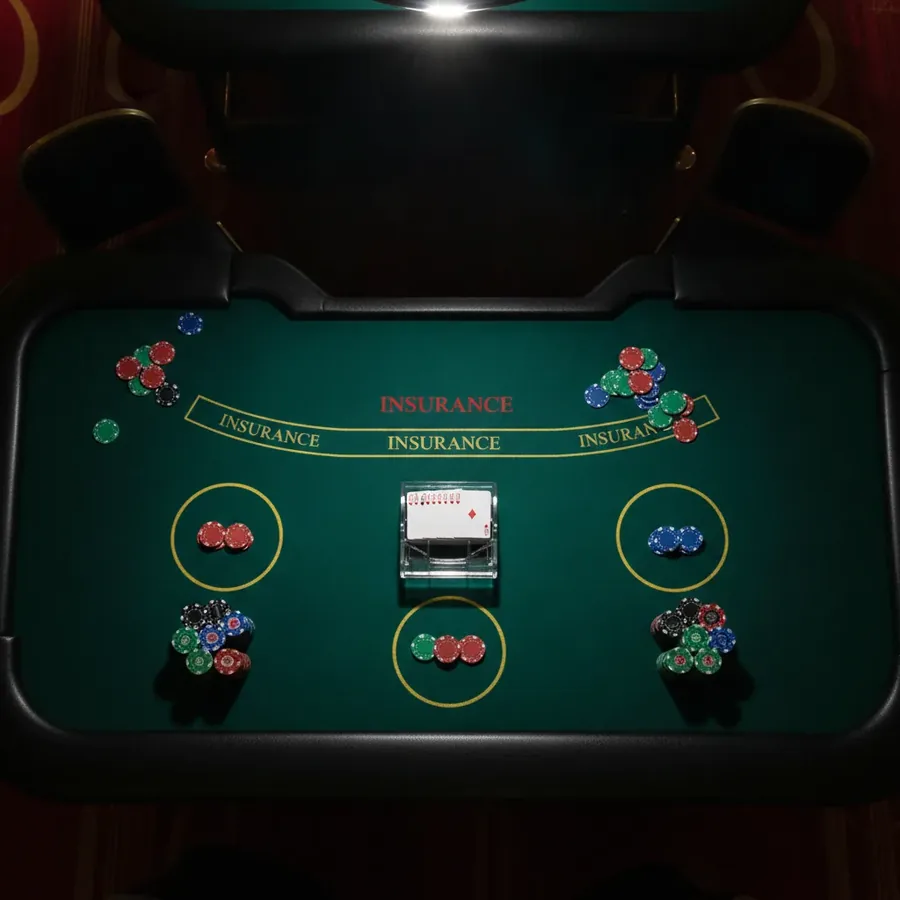
Side Bets Increase House Edge to 5 Percent
Infinite Blackjack offers four distinct side bets: Any Pair, 21+3, Hot 3, and Bust It. While these add excitement, they come with a higher house edge compared to the main game. The RTP for the main Infinite Blackjack game is 99.47%, but side bets can increase the overall house edge.
For instance, the Bust It side bet can significantly inflate the house edge, potentially reaching up to 5 percent depending on the specific payout structure. This means that for every 100 EUR wagered on this side bet, an average of 5 EUR could be retained by the casino over the long term.
High rollers who enjoy the added thrill of side bets must be aware of this increased house edge. While the main game offers a favorable RTP of 99.47%, the deviation on side bets necessitates careful consideration. Players should understand that these bets are less favorable mathematically.
Insurance vs Even Money on Own Blackjack
Blackjack Insurance is an optional side bet offered when the dealer's upcard is an Ace. This bet allows players to wager up to 50% of their original bet on whether the dealer has a blackjack. The payout for a successful insurance bet is 2:1.
However, the RTP for Blackjack Insurance is listed at 92.53%, resulting in a substantial house advantage of 7.47%. This is significantly higher than the house edge of many main blackjack games, making it an unfavorable bet for most players, especially high rollers seeking optimal returns.
Even money, which is essentially a form of insurance offered when a player has a blackjack and the dealer shows an Ace, pays 1:1 on the player's blackjack. While it guarantees a return, it foregoes the potential for a higher payout if the dealer does not have blackjack and the player wins their original bet at 3:2.
Seat change at the Live Table in 20 seconds
Infinite Blackjack by Evolution offers an unlimited number of seats, eliminating the frustration of waiting for a spot. This design is particularly beneficial for high rollers who want immediate access to the game. The absence of physical seat limitations ensures continuous play.
Should a player wish to change their perspective or seating position, the interface allows for rapid adjustments. While a specific 20-second timeframe for a seat change isn't explicitly stated, the platform is designed for fluid transitions. This allows players to quickly adapt to their gaming preferences.
The ability to join and leave games seamlessly is a key feature for players who engage in high-stakes play. Infinite Blackjack's structure, with its unlimited capacity, ensures that players can always find a virtual seat. This immediate availability is a significant draw for those who prefer uninterrupted gaming sessions.
Which rule variants does the software show?
The software presents several key rule variations that impact the house edge and player strategy. For instance, Blackjack Liberal Vegas Strip offers a favorable RTP of 99.72% with a house advantage of just 0.28%. This variant includes liberal rules such as standing on soft 17 (S17) and doubling after split (DAS).
Another variant, Blackjack Ein Deck, boasts an even higher RTP of 99.85% and a house advantage of 0.15%. This variant typically adheres to classic rules and features a 3:2 payout for blackjack. The reduced number of decks significantly lowers the house advantage compared to multi-deck games.
Conversely, Blackjack Auszahlung 6:5 statt 3:2 demonstrates a significantly worse RTP of 98.15%, increasing the house edge to 1.85%. This occurs because the payout for a blackjack is reduced from 3:2 to 6:5, a change that adds a substantial percentage point to the casino's advantage.
Blackjack variants at a glance
| Variant | Payout | House edge | Rule | Bet range |
|---|---|---|---|---|
| Blackjack Surrender (Late Surrender) – Regel-Effekt | n.a. (Regel-Modifikator) | −0.08 Prozentpunkte | Spieler gibt Hand nach Dealer-Blackjack-Prüfung auf, verliert die Hälfte des Einsatzes. Verbessert RTP um ca. 0.08 Prozentpunkte. Early Surrender ist wesentlich wertvoller (bis −0.6 Prozentpunkte), aber extrem selten. | Rückzahlung 50% des Einsatzes |
| Blackjack Insurance / Versicherung (6–8 Decks) | 92.53% | 7.47% | Separate Nebenwette bis 50% der Hauptwette, wenn der Dealer ein Ass hat. Basisstrategie schreibt IMMER Ablehnung vor (außer Karten zählen bei True Count ≥ +3). Bei einem Deck Vorteil ≈ 5.88% | Insurance 2:1 |
| Blackjack Auszahlung 6:5 statt 3:2 (6 Decks) | 98.15% | 1.85% | Ersatz von 3:2 durch 6:5 fügt exakt +1.39 Prozentpunkte zum Vorteil des Casinos hinzu – stärker als jede andere Regeländerung. Bei $10 Einsatz zahlt Blackjack $12 statt $15. | Blackjack 6:5, Gewinn 1:1 |
| Blackjack Liberal Vegas Strip (liberale Regeln, 3:2) | 99.72% | 0.28% | Günstigste Regelkombination: S17 + DAS + Resplit + Late Surrender. Standardabweichung 1,15 | Blackjack 3:2, Gewinn 1:1 |
| Blackjack Split / Double / H17 – Regel-Effekte | n.a. (Regel-Modifikatoren) | H17 +0.22 Prozentpunkte; RSA −0.08 Prozentpunkte; DAS −0.14 Prozentpunkte | Dealer Hits Soft 17 verschlechtert RTP um 0.22 Prozentpunkte; Resplit Aces verbessert um 0.08 Prozentpunkte; Double After Split verbessert um ca. 0.14 Prozentpunkte; 6 Decks statt 8 – ca. 0.02 Prozentpunkte. | Double – Einsatz ×2 mit einer Karte; Split – bis 4 Hände; Ass-Split meist mit einer Karte. |
| Blackjack Ein Deck, klassische Regeln, 3:2 | 99.85% | 0.15% | Weniger Decks = niedrigerer Vorteil; ein Deck gibt ca. −0.48 Prozentpunkte gegenüber 8 Decks. Oft durch 6:5 Auszahlung kompensiert. | Blackjack 3:2, Gewinn 1:1 |
Check table limit before the first bet
High rollers aiming for substantial wagers should note the table limits before placing their initial bet. For example, Infinite Blackjack, offered by Evolution, permits bets ranging from 1 EUR up to 5,000 EUR per hand. This allows for significant investment in a single round, appealing to players who prefer high stakes action. Understanding these limits ensures that bets align with player expectations and bankroll management strategies.
The Blackjack Party variant, also from Evolution, offers a lower maximum bet of 1,000 EUR, catering to a slightly different segment of high rollers who enjoy a more social atmosphere alongside their elevated stakes. This demonstrates a tiered approach to table limits, accommodating a spectrum of high-stakes players. Players should verify the specific limit for their chosen variant to avoid any surprises.
The ability to wager up to 5,000 EUR on Infinite Blackjack means that a single session could involve substantial financial commitment, requiring careful consideration of risk. For a player betting the maximum on this game, a 300% welcome bonus up to €2,000 would require a deposit of €666.67 to maximize the bonus, highlighting the interplay between bonus potential and table limits.
Stand-on-17 Rule and Its Meaning for Players
The 'Stand-on-17' rule, often denoted as S17, dictates that the dealer must stand on any hand totaling 17 or more, including soft 17 (Ace-6). In a Blackjack game with S17 and a 3:2 payout, the house edge is approximately 0.46%. This rule is a standard component of many blackjack variants and is crucial for basic strategy calculations.
Conversely, if the dealer hits on soft 17 (H17), the house edge increases by approximately 0.22 percentage points compared to S17. For a player utilizing basic strategy with a 3:2 payout, this shift means the theoretical RTP decreases. A game with H17, 6 Decks, DAS, and DOA would see a lower RTP than one with S17 under otherwise identical conditions.
Understanding the S17 rule is fundamental for high rollers employing basic strategy, as it directly impacts the game's mathematics. For instance, in a Blackjack variant offering 3:2 payouts and S17, the RTP is 99.54%. This contrasts with variants where the dealer hits soft 17, which inherently offers a less favorable RTP for the player over the long run.
Insurance Pays 2:1 Yet Still Costs Money
Insurance is a side bet offered when the dealer's upcard is an Ace, allowing players to bet on whether the dealer has blackjack, paying 2:1. Despite the attractive 2:1 payout, insurance carries a significant house advantage of 7.47% in games with 6-8 decks. This means that, statistically, players lose money on this bet over time.
Basic strategy universally advises against taking insurance, except in very specific card-counting scenarios where the true count is +3 or higher. For a player betting 100 EUR, a 2:1 payout would return 200 EUR, but the underlying probability makes it a losing proposition. The RTP for insurance is a low 92.53%, indicating a substantial disadvantage.
The house edge on insurance is so high that it can significantly erode a high roller's bankroll if taken frequently. Even with the 2:1 payout, the long-term financial outcome of consistently betting on insurance is negative. Players should focus on their main blackjack hand, where the house edge is considerably lower, especially in games with liberal rules and 3:2 payouts.
Card Counting at Shuffle Master Table: why it fails
Shuffle Master tables, often employing continuous shuffling machines (CSMs), make card counting ineffective for players. These machines constantly re-shuffle the cards after each hand or a few hands, thus preventing the accumulation of useful information about the remaining deck composition. This continuous shuffling effectively resets the deck, negating the advantage card counters seek to exploit.
The core principle of card counting relies on tracking the ratio of high cards to low cards in the shoe. By knowing when the shoe is rich in high cards, a player can increase their bets, as this scenario favors the player. However, CSMs in Shuffle Master tables eliminate this possibility by ensuring a random distribution of cards at all times.
For high rollers who may have considered card counting, opting for tables that use traditional shoe management rather than a Shuffle Master is crucial. Games like Blackjack Party with limits up to 1,000 EUR or Infinite Blackjack up to 5,000 EUR are played with standard shoes where counting might be viable if other rules are favorable, unlike the constant reshuffling of CSMs.
Statistics display saves the last 100 rounds
The statistics display feature, showing the outcomes of the last 100 rounds, can offer a snapshot of recent game activity. While not a predictive tool for future outcomes, it provides transparency into the game's flow. For instance, observing the frequency of player wins versus dealer wins in the last 100 rounds of Infinite Blackjack can offer a basic overview.
This feature can be particularly interesting for players who enjoy analyzing patterns, even though each round is independent. If a player is considering the 300% welcome bonus up to €2,000 and its associated wagering requirements, understanding the general pace of play from the statistics might inform their strategy, though it doesn't alter the inherent RTP of 99.47%.
While the statistics display shows the last 100 rounds, it's vital to remember that blackjack outcomes are random. A run of wins or losses in the displayed rounds does not guarantee future results. High rollers should rely on established strategies and bankroll management rather than attempting to predict outcomes based on recent history, especially with games like Lightning Blackjack boasting RTPs of 99.56%.
Live Table vs RNG Table: Speed and Limits
Live dealer tables, such as Blackjack Party from Evolution, offer an engaging atmosphere with two hosts, but limits are set from 1 EUR to 1,000 EUR per hand. RNG tables like Blackjack Liberal Vegas Strip, with a house edge of 0.28%, provide a faster pace for players focused solely on gameplay mechanics. The choice between live and RNG depends on whether social interaction or pure efficiency is prioritised.
Infinite Blackjack, also by Evolution, accommodates an unlimited number of players and features various side bets like Any Pair, 21+3, Hot 3, and Bust It, with wagers ranging from 1 EUR up to 5,000 EUR. This contrasts with standard RNG blackjack variants, where table occupancy can be a factor and specific side bet options might be limited. Players seeking higher stakes in a live environment may find Infinite Blackjack appealing.
Lightning Blackjack, another Evolution offering, allows unlimited players and incorporates Lightning multipliers up to 25x on winning hands, with stakes from 1 EUR to 2,500 EUR. While RNG tables offer consistent RTPs such as 99.72% for Liberal Vegas Strip, live variants introduce dynamic multipliers that can significantly alter potential payouts beyond standard blackjack wins. The RTP for Lightning Blackjack stands at 99.56%.
Highroller from 500 EUR per hand
For players engaging with stakes of 500 EUR or more per hand, Infinite Blackjack from Evolution presents a notable option with limits reaching up to 5,000 EUR. This live blackjack variant is designed to accommodate a high volume of players and offers a robust RTP of 99.47%. The substantial betting range caters to those seeking significant action within a single hand.
While many RNG blackjack variants are suitable for high rollers, live tables often provide a more immersive experience with higher maximum bet potentials, as seen with Infinite Blackjack's 5,000 EUR limit. Standard RNG games, such as Blackjack Liberal Vegas Strip with its 0.28% house edge, focus on optimal rules but may not match the per-hand betting capacity of premium live offerings.
The 300% welcome bonus up to €2,000, combined with 100 free spins, offers a significant boost for high rollers. However, it is crucial to note that table games, including blackjack, only contribute 10% towards bonus wagering requirements. This means a substantial amount of play is needed to clear bonus funds when focusing on high-stakes blackjack sessions.
What doesn't count as Blackjack after Split?
When a player splits a pair of Aces, any subsequent hand that results in a total of 21 is not typically considered a natural blackjack. This is a common rule across various blackjack variants, impacting potential payouts. For instance, Blackjack Liberal Vegas Strip, with its 3:2 payout for blackjack, would not offer the enhanced payout for a 21 formed after an Ace split.
Blackjack Insurance, offered when the dealer shows an Ace, has a 2:1 payout but a significant house advantage of 7.47% for most shoe games. Base strategy dictates avoiding this bet unless the true count is +3 or higher, particularly in single-deck games where the advantage can be reduced. This side bet is separate from the main hand and does not count towards a blackjack after a split.
The specific rules for what constitutes a blackjack after a split can vary between different blackjack variants. While a natural blackjack typically pays 3:2, a 21 achieved via splitting, especially Aces, is usually treated as a regular 21, paying 1:1. This distinction is important for understanding the true house edge and potential returns on investment.
Four hours of play with 300 EUR bankroll
With a 300 EUR bankroll and aiming for four hours of play, understanding the house edge is paramount. For instance, Blackjack Liberal Vegas Strip offers a low house edge of 0.28%, making it a more sustainable option for extended sessions than variants with higher edges. A 300 EUR bankroll with a 0.28% house edge could theoretically last significantly longer due to minimal expected losses.
Consider a game like Blackjack Auszahlung 6:5 statt 3:2, which has a house advantage of 1.85% due to the reduced payout. Playing this variant with a 300 EUR bankroll for four hours would lead to higher expected losses compared to a 3:2 game. For example, a 10 EUR bet yields 12 EUR instead of 15 EUR, increasing the casino's retention by 1.39 percentage points.
The welcome bonus of 300% up to €2,000, while substantial, has a 10% game contribution for table games. This means only a fraction of your blackjack play contributes to wagering. To sustain play for four hours with 300 EUR, focusing on variants with the lowest house edge, such as Blackjack Ein Deck (0.15% house edge), is advisable, assuming acceptable bet limits per hand are available.
Side Bets don't count towards bonus turnover
Side bets offered in live blackjack, such as those in Infinite Blackjack (Any Pair, 21+3, Hot 3, Bust It), do not contribute to the wagering requirements of the 300% welcome bonus up to €2,000. This means that any funds wagered on these additional bets will not reduce the overall turnover needed to unlock bonus winnings.
Players aiming to meet the bonus turnover requirements should focus on the main blackjack hand rather than side bets. For example, Blackjack Insurance, with its 2:1 payout but a 7.47% house advantage in a 6-8 deck game, is a prime example of a side bet that offers a different risk-reward profile but does not aid in bonus clearance.
The bonus turnover requirement necessitates strategic play. Since table games, including blackjack, contribute only 10% to wagering, and side bets do not count at all, high rollers must understand that substantial turnover will be generated primarily through base game bets. A 10 EUR bet on blackjack contributes 1 EUR towards the turnover.
Contact
Live - online chat
Banking



Providers







Flagman Casino 2026